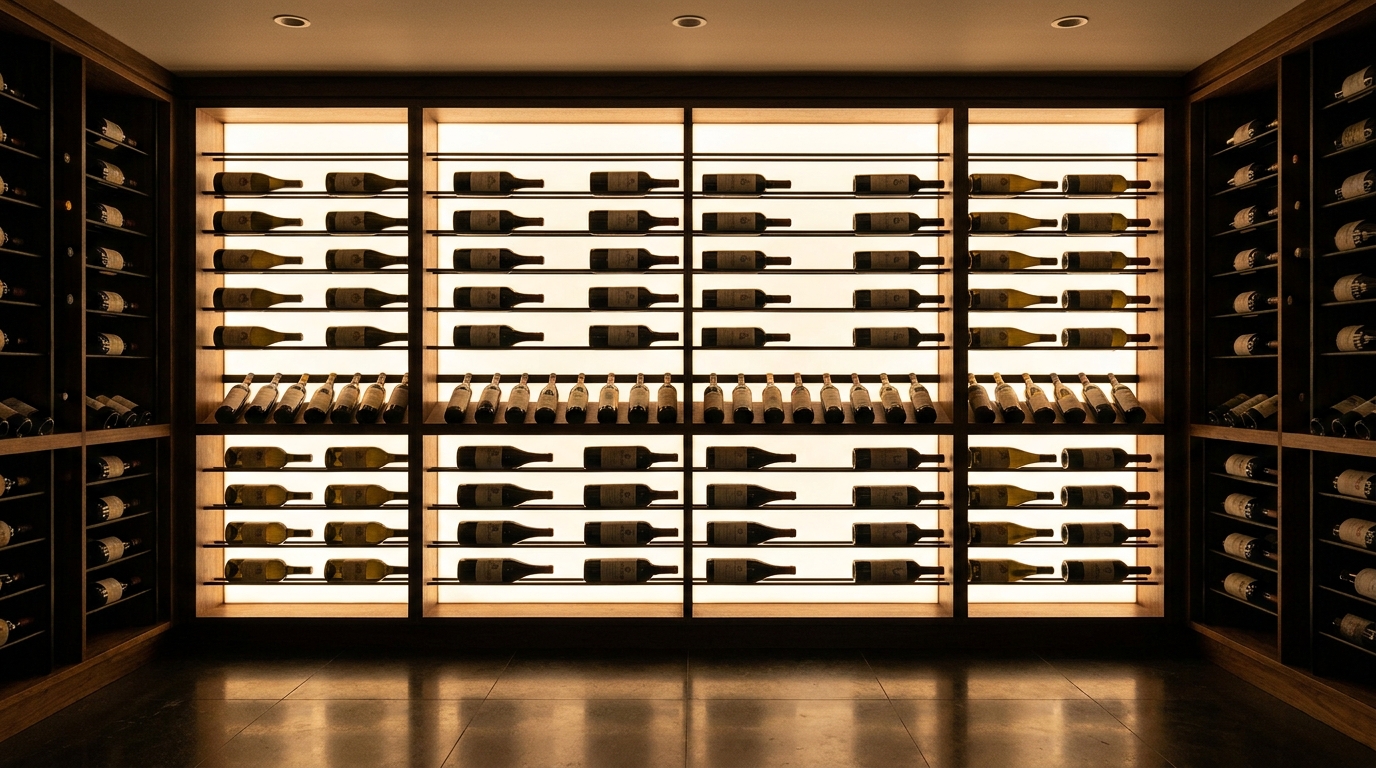
There is a moment in almost every wine cellar or wine wall project where the design stops being about the rack and starts being about the light. A well-built rack full of bottles, lit from the ceiling with downlights, reads as storage. The same rack with an evenly illuminated plane behind it reads as architecture — every bottle becomes a silhouette, the glass picks up colour, and the wall turns into the focal point of the room.
That difference is what backlit wine rack lighting does. It is one of the most common applications we build custom backlit light panels for, in both private residences and restaurants. This guide covers how the lighting actually works, the mistakes that show up in finished installations, and what you need to know before specifying a panel for your own project.
Why Front Lighting Fails on a Wine Wall
Most wine displays are lit the way the rest of the room is lit: from above, from the front, with spots or strips aimed at the bottles. It rarely looks the way the renderings promised, for three reasons.
Glass reflects. A bottle is a curved, glossy surface, so a point source in front of it produces a bright specular hotspot and a lot of glare. Multiply that by fifty bottles and you get a wall of small competing highlights instead of one clean image.
Shadows fall the wrong way. Front lighting throws each bottle's shadow backward into the rack, so the depth of the display gets lost in dark voids between rows.
Colour disappears. The most striking thing about wine in glass is that the liquid is translucent. Light has to pass through it for that to show. Light bouncing off the front of the bottle never reveals the colour inside — it just makes the label brighter.
Backlighting reverses all three. The light source sits behind the bottles as a diffuse surface rather than a point, so there are no hotspots. Shadows project forward into the room, giving the display real depth. And the light travels through the glass, so a rack of reds glows in a range of garnets and rubies that no front-lit installation can reproduce.
How a Backlit Wine Rack Panel Is Built
The visible result is simple — an even, glowing plane. Getting there is a matter of construction.
A backlit light panel is an aluminum housing with LED bars distributed throughout the interior, not just along the edges, topped with a diffuser. The LED spacing, the cavity depth, and the diffuser together determine whether you see a smooth field of light or a row of visible dots. Get the ratio wrong and the panel "pixelates" — you can count the LEDs through the diffuser, which is immediately obvious behind clear bottles.
That is the key distinction between a backlit panel and the alternatives people try first. LED strip tape stuck to the back of a cabinet gives you visible dotting and hard banding. Edge-lit acrylic panels give beautiful even light but have a practical size ceiling — up to roughly 48"×96" in our acrylic light panel line — because the light has to travel inward from the perimeter. For a full-height wine wall, a backlit aluminum panel with internal LED bars is the format that holds even illumination at any size. There is no upper size limit on what we build.
Every panel we make is manufactured in-house at our Richmond Hill, Ontario facility, cut to the customer's exact dimensions. There are no standard sizes to pick from and design around — the panel is built to the opening, which for a wine wall usually means matching the millwork bay exactly so the finished edge disappears behind the rack.
Getting the Details Right
A few specifics separate a wine wall that looks professionally designed from one that looks like an afterthought.
Colour temperature
Warm white in the 2700K–3000K range is almost always the right call for wine. It flatters red wine in particular, reading as candlelight rather than refrigeration. Cooler temperatures around 4000K and up push the whole wall toward a retail-cooler look. If the surrounding room is finished in walnut, brass, or warm stone, staying warm keeps the wall integrated rather than fighting the palette.
RGB is available if a project calls for colour-changing capability, and it does get specified for bars and hospitality spaces where the room shifts mood through the evening. For a residential cellar, fixed warm white is usually the more sophisticated choice.
Dimming
Specify a dimmer. Every panel we build is dimmable and works with a standard wall dimmer or a remote-controlled dimmer. A wine wall at full output is dramatic during a dinner party and far too bright as ambient light on a Tuesday. Being able to run it at 30% turns the same fixture into a night light for the room.
Heat
This is the question people ask first, and the answer is straightforward: LED panels run cool. Unlike halogen or incandescent sources, an LED panel produces very little radiant heat, and the aluminum housing dissipates what it does produce across the whole back surface rather than concentrating it. That matters because heat is genuinely bad for wine — sustained warmth accelerates aging and can push corks. A properly built LED panel behind a rack does not create the thermal load that a comparable halogen installation would. In a temperature-controlled cellar, it is a non-issue; in an ambient-temperature display wall, it is still the safest lighting choice available.
Depth and mounting
Plan the cavity early. A backlit panel needs a few inches of depth behind the rack face, plus a path for the power supply lead. The best-executed installations we see are the ones where the cabinetmaker and the panel dimensions were coordinated before the millwork was built, so the panel sits flush inside the bay with the rack mounted in front of it. Retrofitting into a bay that was framed without accounting for the panel is possible but always more work.
Bottle orientation
Bottles stored on their sides — the correct orientation for cork-sealed wine — present the base of the bottle to the room and the length of the bottle in silhouette against the panel. Racks that display bottles label-out look better front-lit; racks that store them properly look dramatically better backlit. Most wine walls are a mix, and the panel handles both.
What Ships With the Panel
A custom backlit panel from Prime Light Boxes arrives ready to install. Every unit is CSA/UL certified to North American electrical safety standards and includes a UL/ETL-approved power supply sized with 20% extra capacity — that is always in the box, never a separate line item. The LEDs are rated for 50,000+ hours, and every product carries a 3-year warranty.
Most orders ship within one to two weeks, and smaller units can go out in as little as two days. Rush production is available if a project timeline moves. Shipping is free within Canada, and orders to the United States ship duty-free and tax-exempt under CUSMA.
Beyond the Cellar
The same panel format shows up in adjacent applications constantly. Restaurants and hotel bars use backlit bottle displays behind the bar rail for exactly the same reason a homeowner does: the product becomes the light fixture. Onyx and stone backlighting uses identical panels behind translucent slabs on feature walls and bar fronts, and the two are often specified together in the same room — a backlit onyx bar face facing a backlit wine wall, both running off dimmers on the same scene.
If you are working through a wine wall project, the most useful thing you can do is bring dimensions to the conversation before the millwork is finalized. We build to whatever those dimensions are, and we would rather size the panel to your design than have you size your design to a catalogue.
Talk to us directly at 416.269.0447 or sales@primelightboxes.com, or request a custom quote with your dimensions and we will come back with pricing and a lead time.