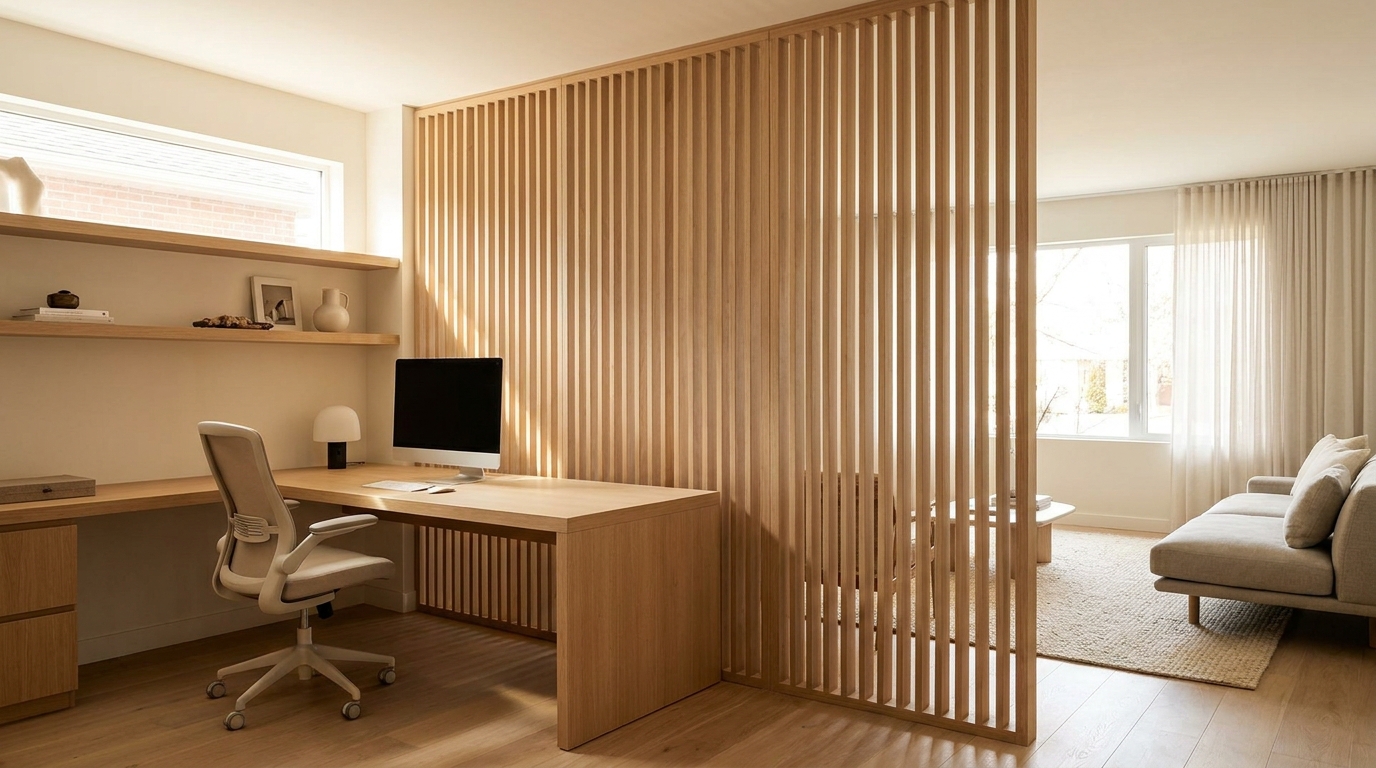
The Home Office That Never Got Its Own Room
Most homes weren't designed with a dedicated office in mind. Work from home arrangements pushed a desk into whatever open corner was available — the end of the living room, a nook off the dining area, a stretch of loft space with a view of everything else going on in the house. It works, until it doesn't: a video call gets interrupted by the kitchen, focus breaks every time someone walks past, and the desk never quite feels like a real workspace.
A full wall is one way to fix that, but it's a permanent renovation with permits, drywall, and a room that stops being open-concept at all. A wood slat room divider solves the same problem with a lighter touch — a professionally installed, floor-to-ceiling architectural feature that draws a clear line around a home office while keeping the rest of the floor plan intact.
Why Slats Work Better Than a Wall for a Home Office
The instinct with a home office is to wall it off completely for privacy. But a solid wall also blocks the natural light and sightlines that made the open floor plan appealing in the first place — and it can make a small office feel like a box.
A wood slat divider splits the difference. The evenly spaced slats interrupt sightlines enough to signal "this is a separate space" and reduce visual distraction from the rest of the room, while still letting light pass through and air circulate. Anyone glancing over sees a rhythm of wood, not the person on a call or the pile of files on the desk — enough separation to feel like a real office, without the room going dark.
There's an acoustic benefit too. Wood slat panels won't match a solid wall's sound isolation, but the material and spacing break up sound reflection and take some of the edge off noise bouncing between an open kitchen or living room and a workspace — useful for cutting down on the low hum of a household while someone is trying to concentrate on a call.
Choosing ROTERA or FIXERA for a Home Office
Primo Panels' SKANDINAVIA dividers come in two systems, and the choice matters more for a home office than almost any other room.
FIXERA is the fixed-slat system — the divider stays in one orientation permanently. It's the simpler, more architectural option, and it suits an office that's meant to read as a defined room every day, not something that changes throughout the day.
ROTERA uses rotating slats, so the angle can be adjusted from more open to more closed. For a home office, that adjustability is genuinely useful: rotate the slats more closed during a focused work block or a video call, then open them up in the evening when the space reverts to part of the living area. It's the better fit for anyone using the same footprint as both office and shared family space depending on the time of day.
Either way, both systems install as a permanent architectural feature — glued and screwed to the ceiling and floor — not a freestanding screen that gets shuffled around the house.
Finish and Sizing for a Workspace
Home offices tend to already have a fair amount of visual noise — monitors, cables, shelving — so the finish is worth thinking through:
- White Oak keeps the space feeling bright and calm, which pairs well with a home office that doesn't get much natural light of its own.
- Walnut or Dark Walnut reads more grounded and focused, closer to a traditional study, and works well when the office sits in a room with warmer existing tones.
- Paintable MDF slats are the option if the divider needs to match a specific wall color or trim rather than stand out as a wood feature.
On sizing, a 2"x4" slat profile keeps the divider visually light, which helps a home office feel like part of the room rather than a wall-off. A 2"x5" or 2"x6" profile reads bolder and blocks more sightline per slat, worth considering if the office backs onto a busy hallway or entryway. Standard lengths run 8 to 12 feet, which covers most residential ceiling heights, and custom cross-sections are available for vaulted or sloped ceilings.
What It Costs and How It's Installed
SKANDINAVIA dividers are sold per slat with a 12-slat minimum, so the total cost scales with how much of the office boundary needs to be enclosed rather than a flat room price. Pre-finished veneer finishes (Walnut, Dark Walnut, White Oak, and unfinished/stainable) start at $130.00 CAD per slat for an 8ft, 2"x4" configuration; paintable MDF starts at $90.00 CAD. Primo Panels' Build and Price tool takes the wall width and ceiling height for the office area and returns an exact slat count and price.
Installation is professional-grade and permanent — slats are mounted to the ceiling and floor, not propped or clipped in place — which is the right call for a home office that's meant to function as a real room, not a rearrangeable accessory. Shipping is a flat $400 fee that covers customs and brokerage on cross-border orders, with no surprise fees at delivery, and free samples are available in every finish to check against the office's existing flooring and trim before committing to a full order.
Building a Room That Actually Feels Like an Office
The difference between "a desk in the corner" and an actual home office usually comes down to boundaries — something that signals where the workspace starts and stops, both visually and mentally. A permanent wood slat divider draws that line without the cost, mess, or light loss of a full wall, and with ROTERA, it can flex between fully closed for focus time and opened up when the office reverts to shared space in the evening.
For anyone ready to define a real home office out of an open floor plan, Primo Panels' SKANDINAVIA wood slat room dividers are built to measure, ship with all customs and duties included, and install as a permanent architectural feature — not a temporary fix.